Pitch Deck Design Agency
The AI Startup Seed/Series A Deck: Picking the Right Pitch for the Market That Can’t Stop Moving
A Presentation Gurus breakdown: how to build a winning Gaming, Web3, AI & Emerging-Tech Decks pitch.
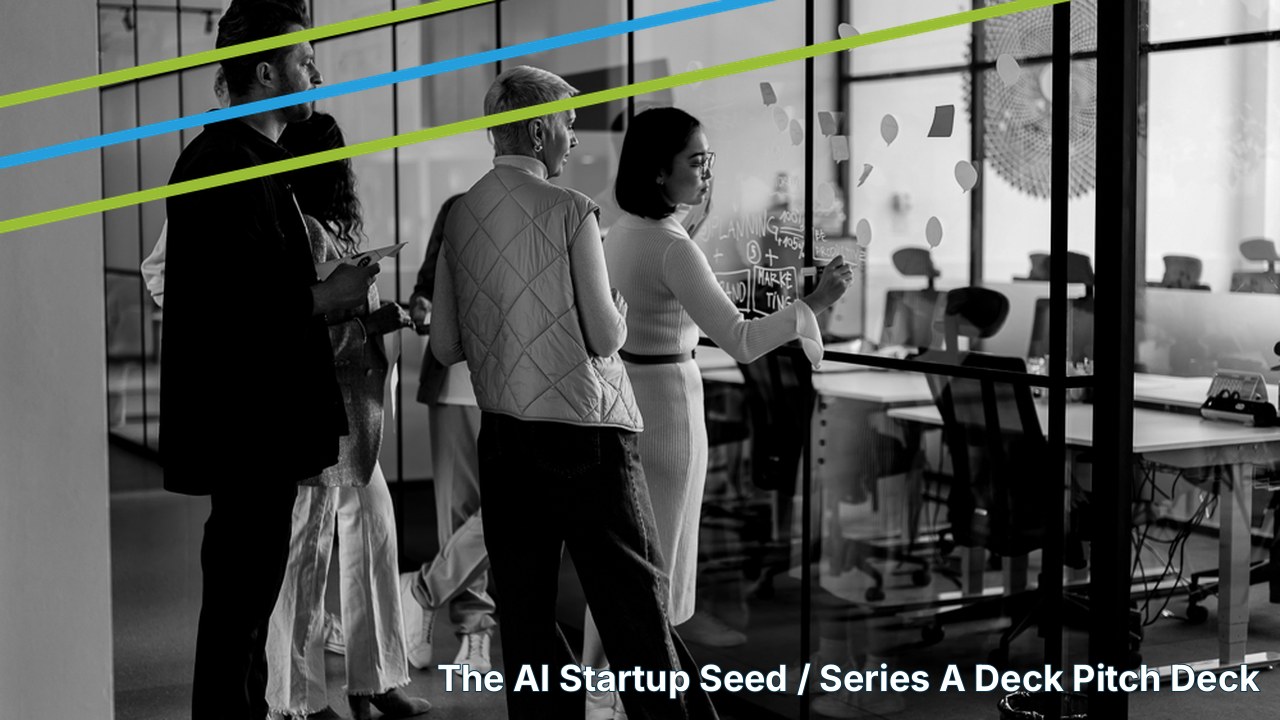
Presentation Gurus — Pitch Deck Breakdown: The AI Startup Seed / Series A Deck
Highlight
- Investors at Seed and Series A now treat AI-specific risk—like defensibility timing, compute cost escalation, and regulatory tail—as separate from standard startup risk; your deck must surface and address each explicitly.
- A data moat slideset that only claims volume without showing feedback-loop velocity, unit economics of the data pipeline, or proprietary acquisition cost is indistinguishable from a toy project.
- The ‘model advantage’ claim collapses the moment the venture investor can name three open-source or API-based alternatives that do 80% of the same work; your deck must preempt that comparison with a concrete technical moat, not a vague one.
- Seed and Series A investors in AI have a private doubt that the team is more excited about the technology than the market, so the go-to-market section must prove you have already found a paying customer contour, not just a demo.
- This deck follows an Investment/Funding Arc structured as a cumulative proof stack, where each section (model, data, use case, GTM) must be independently strong because investors skip between them in unpredictable order.
Presentation Design Process
Four Steps, One Simple Process
This is a straightforward, side-by-side collaboration designed to remove all the traditional complexity from the process. We work together seamlessly via Microsoft Teams or your preferred online platform, sharing our screens to review layout, story, and graphics in real time. This allows us to capture your immediate feedback and make instant adjustments on the spot.
It completely eliminates the old, slow friction of scheduling formal office visits and waiting days for revisions. It is faster, highly convenient, and ensures you get exactly what you need to succeed.
Presentation Discovery
We start by learning exactly who’s in the room, then how you want to use the slide deck, the core message, and the one goal it needs to achieve the moment you finish presenting.
Story & Design
First, we build two custom visual direction slide concepts, matched to the goal of the slide presentation. We also map out the story in a simple, un-styled wireframe. Both are completed side-by-side.
Fast Revisions
Quick morning sprints refine the deck together in real time, getting shorter each round, from a full assembly session down to just minutes, until every slide is locked in.
Full Handoff
After revisions, and when you are 100% satisfied with the presentation, you settle the invoice. You’ll get a fully editable file in PowerPoint, Keynote, or Google Slides, plus a half-hour coaching session so you can present with total confidence.
Ready ToGet Started?
Presentation Gurus is open.
Give us a call.
We actually answer the phone.
The Pitch That Starts with a Question, Not an Answer
The first slide of an AI startup deck at Seed or Series A should not be a logo, a tagline, or a splash screen of a futuristic interface. It should be a question that makes the investor’s mental model of AI investing snap into focus: Is this a defensible technical wedge, or a wrapper that will be commoditized before the Series B? That tension—the gap between the excitement around a new model and the reality of competition in a market where the barriers to entry for training a base model have dropped dramatically—defines why this deck type is so difficult to get right. Investors in this category are not looking for a technology demonstration. They are looking for an argument that this particular AI application will have a structural advantage in a space where algorithms, data, and compute cycles are all on a rapidly accelerating treadmill. The opening cannot be a generic ‘AI is the future’ statement. It has to be a direct response to the fear that the investment is funding a temporary moat around a model that will be overtaken by an open-source release in six months. The stakes are not whether the technology works. The stakes are whether the technology works in a way that creates a business, not just a demo.
Why AI Pitching Is Its Own Category of High-Stakes
The forces shaping AI venture capital in 2025 make this deck type a fundamentally different animal than a SaaS or biotech deck. First, the compute cost dynamic is singular: training and inference budgets can swallow a Seed round before a single customer is onboarded, which forces investors to scrutinize unit economics from the first slide, even at the pre-revenue stage. Second, the regulatory landscape is in motion in a way that directly impacts defensibility. The EU AI Act, the White House Executive Order on Safe, Secure, and Trustworthy Development of AI, and emerging state-level frameworks create a compliance cost that an AI startup must acknowledge, not ignore. Third, and most structurally significant, the availability of high-quality open-source models (the Llama, Mistral, and Phi families) means that a closed-source proprietary model must demonstrate a clear advantage, often in latency, fine-tuning for a specific vertical, or inference cost per query. The deck that does not address all three of these pressures—compute cost sustainability, regulatory posture, and the open-source benchmark—looks like it was written in a vacuum. Investors in this space have seen too many AI pitches that lean heavily on the word ‘transformer’ without showing the transformer-based specific performance gain over a free alternative. The decision-maker private doubt that this deck must solve is: ‘Are you building a defensible asset, or are you renting a technology that will be free tomorrow?’
Building the Proof Stack: Model, Data, Use Case, GTM
The sequence of an AI Seed/Series A deck functions as a cumulative proof stack, and the investor will skip between sections depending on their own expertise. A computer science partner might jump straight to the model advantage slide, while an operator partner might go to the go-to-market section first. The deck must be structured so that each of four sections—model advantage, data moat, use cases, and go-to-market—stands alone and is independently strong. Begin with the model advantage, but do not lead with a generic architecture diagram. Lead with the specific performance benchmark against the best open-source alternative on a task that matters for your market. If your model is fine-tuned Llama 3 for medical coding, show the accuracy gain on a specific medical coding dataset, not a generic perplexity score. The data moat section is where most AI decks fail. Claiming ‘we have a lot of data’ is not enough. The slide must show the feedback loop velocity: how quickly new data from user interactions flows back into the model to improve it, the unit economics of acquiring that data, and why competitors cannot replicate it. The use cases section must show a real customer problem, not a hypothetical one. Use a case study format with a named vertical, the specific inefficiency before your model, and the quantifiable reduction in cost or time. The go-to-market section at Seed/Series A is not about a broad TAM slide; it’s about proving you know the purchase process for your first target buyer—who signs the contract, what the sales cycle length is, and what the price point looks like. The funding ask slide should tie directly to compute cost, data acquisition, and the go-to-market team you need to hire, not to a generic ‘talent and growth’ line.
Crossing the Technical-Communication Gap with Presentation Gurus
The single craft gap that trips up AI founders is the distance between a technically precise slide (one that a PhD co-founder would approve) and a decisionally clear slide (one that a general partner who last wrote code in 2009 can act on). Many AI decks swing too far in one direction: either a slide with a transformer architecture diagram that stops the meeting cold, or a slide that oversimplifies to the point that an ML engineer on the investor team dismisses it as naive. Presentation Gurus helps founders navigate this specific tension by building a slide architecture that layers technical depth behind calls to action, so that the partner who needs to see the ablation study can find it on a supplemental slide, while the partner who needs to sign off on the valuation sees a clear, defensible claim. This is not a template job. It is a structural negotiation between the complexity of the technology and the limited attention budget of a venture capital meeting. The same rigor applies to the regulatory posture slide, which most AI decks either skip entirely or bury in an appendix. A properly structured deck surfaces the regulatory risk and the team’s strategy for managing it in the main flow, because leaving it out signals that the team hasn’t thought about it.
The Investment/Funding Arc: When the Investor Skips to Slide Nine First
The narrative shape of an AI Seed/Series A deck is an Investment/Funding Arc calibrated for non-linear review. In this deck type, the investor has a behavioral tic that is central to the deck’s design: they will jump straight to the data moat or model advantage slide within the first two minutes. They have been burned by too many AI pitches that had a great demo but no defensibility, and they are looking for the specific evidence that this team has a moat that survives the open-source test. The Investment/Funding Arc here is built around the cumulative proof shape: each section (model, data, use case, GTM) is a brick in a wall, but the wall cannot have a weak brick because the investor hits them in random order. The arc establishes structural technical advantage, proprietary data assets, market validation, and a concrete monetization pathway. The emotional movement for the investor is from skepticism (I bet this is just a wrapper) to curiosity (the benchmark is real) to conviction (the data feedback loop is defensible and the GTM is specific) to commitment. The pitch works as a cognitive audit for the investor, whose attention is driven by the immediate pressure to identify and avoid a trough-of-disillusionment trap. The deck must anticipate where the investor will look first, and make that slide the strongest one in the stack.
Conclusion
The AI Seed/Series A deck lives or dies on its ability to make the investor believe that this specific model, applied to this specific use case, with this specific data pipeline, will survive the commoditization wave that is coming for every AI company without a real moat. The stakes are not abstract. The investor is betting on whether the team has the technical judgment and market focus to turn a model into a business before compute costs or open-source alternatives erase the advantage. When the deck is built as a cumulative proof stack with independent sections, the founder protects the meeting from that one slide that kills the deal. The outcome the reader should walk away with is not ‘I need a better deck’ but ‘I need a deck that structures my technical and market defensibility so clearly that the investor has nothing to find wrong.’
If you need help creating a winning Gaming, Web3, AI & Emerging-Tech Decks pitch and would like our presentation specialists’ help, call J.R. for a complimentary discovery and review of your project.
References
-
CB Insights
— The Top 12 Reasons Startups Fail — https://www.cbinsights.com/research/startup-failure-reasons-top/
Grounding the failure mode where AI startups fail to show defensibility, not market need. -
Stanford HAI
— AI Index Report 2024 — https://hai.stanford.edu/ai-index/2024
Providing the benchmark context for open-source model performance and compute cost trends that investors use to evaluate moats. -
European Union
— EU AI Act — https://artificialintelligenceact.eu/
Establishing the regulatory landscape that an AI startup deck must acknowledge for compliance-cost credibility. -
U.S. White House
— Executive Order on Safe, Secure, and Trustworthy Development and Use of Artificial Intelligence — https://www.whitehouse.gov/briefing-room/presidential-actions/2023/10/30/executive-order-on-the-safe-secure-and-trustworthy-development-and-use-of-artificial-intelligence/
Showing the U.S. regulatory context that an AI startup must factor into its risk disclosure and go-to-market timing. -
Crunchbase
— AI Venture Funding Data (2023–2025) — https://about.crunchbase.com/
Referencing the market data investors use to calibrate round sizes and valuations for AI Seed/Series A deals. -
Sequoia Capital
— AI's $200 Billion Question — https://www.sequoiacap.com/article/ais-200-billion-question/
Highlighting the specific compute-cost and revenue-context challenge that AI decks must address directly. -
Scale AI
— The Data Moat Advantage — https://scale.com/blog/data-moat-ai
Supporting the argument that data feedback loops and proprietary acquisition are the real moats, not raw model parameters. -
a16z
— How AI Companies Can Build a Moat — https://a16z.com/how-ai-companies-can-build-a-moat/
Providing the investor-side framework for evaluating defensibility that the deck must preemptively satisfy.
Written By Presentation Gurus

Creative Director
J.R. founded Presentation Gurus in 1997, growing a marketing side hustle into a global studio serving startups, investors, and Fortune 500s. With three decades of experience, he personally leads every project as the client contact. He applies this same narrative-first process—honed across thousands of pitches—to every article, guide, and case study. Learn More
More Pitch Deck Breakdowns

The AAA Game Publisher Greenlight Deck: How to Sell a Vision Before the Code Exists
Read the breakdown →
The AR/VR / Spatial-Computing Product Pitch: Selling the Interface, Not the Goggles
Read the breakdown →
The AgriTech Venture Pitch: When the Buyer Isn’t the User
Read the breakdown →