Pitch Deck Design Agency
The Investor Progression / Office-Hours Deck: Why Your Most Important Pitch Document Isn’t the Pitch Deck
A Presentation Gurus breakdown: how to build a winning Investor Relations & Financial Decks pitch.
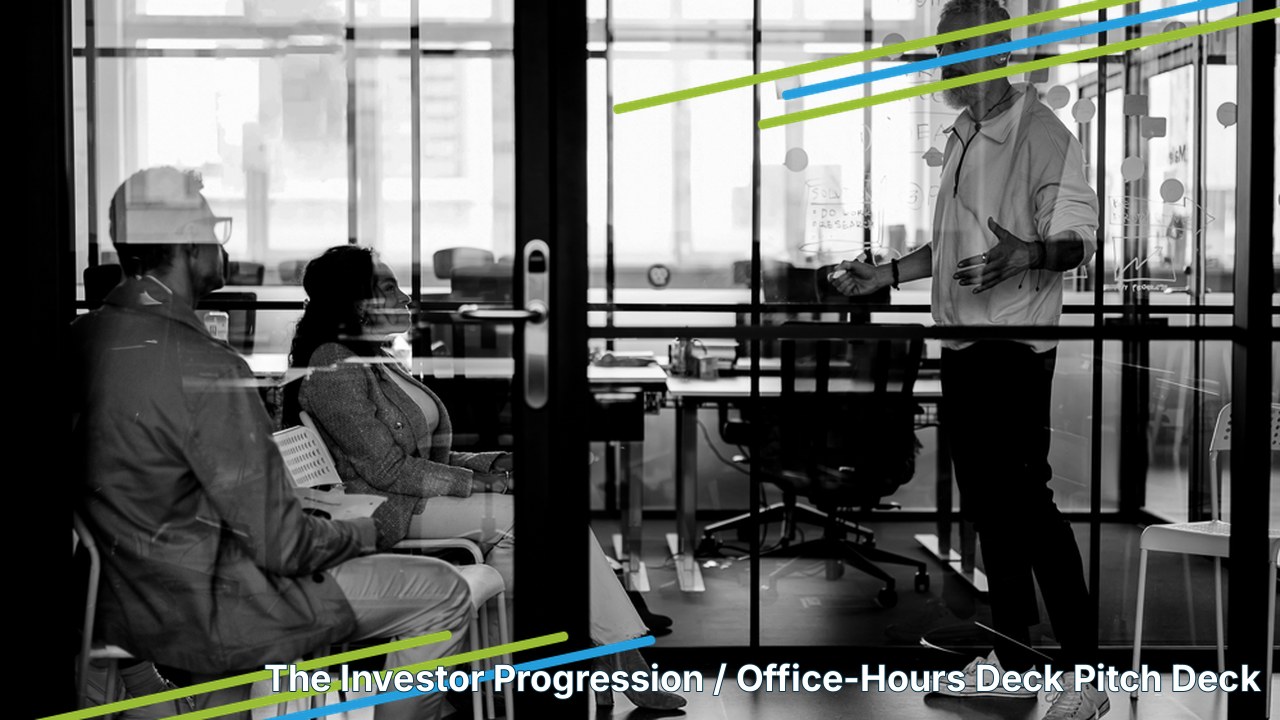
Presentation Gurus — Pitch Deck Breakdown: The Investor Progression / Office-Hours Deck
Highlight
- The office-hours deck is not a fundraising tool but a pattern-recognition device — its purpose is to let a founder see the shape of their own process in real time.
- A proper progression deck tracks the tension between the company’s story (what you say) and the market’s response (what the room actually hears), and forces the two to converge.
- Founders who maintain a live objection log across investor meetings can detect whether a concern is an isolated blind spot or a structural problem with the business model itself.
- The deck must be organized around the investor’s unspoken trajectory from awareness to conviction, not the founder’s chronological workflow across meetings.
- A well-maintained office-hours deck often proves more valuable during a board review or down round than the polished pitch deck ever was, because it documents the founder’s learning rate in a way no static narrative can.
Presentation Design Process
Four Steps, One Simple Process
This is a straightforward, side-by-side collaboration designed to remove all the traditional complexity from the process. We work together seamlessly via Microsoft Teams or your preferred online platform, sharing our screens to review layout, story, and graphics in real time. This allows us to capture your immediate feedback and make instant adjustments on the spot.
It completely eliminates the old, slow friction of scheduling formal office visits and waiting days for revisions. It is faster, highly convenient, and ensures you get exactly what you need to succeed.
Presentation Discovery
We start by learning exactly who’s in the room, then how you want to use the slide deck, the core message, and the one goal it needs to achieve the moment you finish presenting.
Story & Design
First, we build two custom visual direction slide concepts, matched to the goal of the slide presentation. We also map out the story in a simple, un-styled wireframe. Both are completed side-by-side.
Fast Revisions
Quick morning sprints refine the deck together in real time, getting shorter each round, from a full assembly session down to just minutes, until every slide is locked in.
Full Handoff
After revisions, and when you are 100% satisfied with the presentation, you settle the invoice. You’ll get a fully editable file in PowerPoint, Keynote, or Google Slides, plus a half-hour coaching session so you can present with total confidence.
Ready ToGet Started?
Presentation Gurus is open.
Give us a call.
We actually answer the phone.
The Document Everyone Forgets Until It’s Too Late
The sixty-second call with a lead partner at Sequoia doesn’t leave a trace. The confused question from a family office that just didn’t get the unit economics — that evaporates too. By the time a founder sits down for the second meeting with a serious fund, the only record of what was said is a fragmented memory and a few Slack messages between co-founders. The most common reason a round stalls is not a bad product or a bad market — it’s a founder who cannot hear the pattern in the noise. They keep telling the same story to different people, unaware that ten investors are raising the same objection, in six different phrasings, and none of it is landing.
An office-hours deck exists to solve that specific failure mode. It is not a pitch deck dressed in different clothes. It is an operational instrument — a living document that captures who was met, what they said, what the founder is learning, and how the narrative is being reshaped in response. It treats fundraising not as a series of isolated conversations but as a single, iterative research process. The stakes are straightforward: a founder who builds this document well will close faster and on better terms than one who doesn’t, because they will walk into the room with a story that has already been tested and sharpened against real skepticism.
Why This Deck Type Gets Built When It’s No Longer Useful
Every startup that goes through a painful fundraise after the fact wishes they had kept a progression deck — yet almost no startup builds one proactively during the era of low friction, when the easy closes are happening and the objections feel manageable. The few founders who do maintain this discipline are typically second-time or third-time operators who learned the hard way that the most expensive mistake in fundraising is repeating the same pitch to fifty people without changing a single slide.
This deck lives in a different tension than a standard pitch deck. A pitch deck is a broadcast medium: it says what the company wants the world to know. An office-hours deck is a feedback loop: it records what the world tells the company back. The discipline required to maintain it runs against every founder instinct, because it forces the creator to stare at their own failures in granular detail. Every objection logged is a rejection memorialized. Every revised narrative is an admission that the previous version was incomplete. The cognitive load is real, and it’s why most founders abandon the practice after the first week, returning to the comfortable illusion that they will just remember what the last partner said.
The external pressure that makes this deck non-optional is the collapse of market signal density in a slow fundraising environment. When capital was abundant, a founder could afford to disregard a single lukewarm response. In a capital-constrained cycle, the absence of a progression deck means the founder is effectively fundraising blind — guessing at which objections matter, which VCs are worth re-engaging, and which narrative thread is actually working.
Building the Sequence: From Log to Lens to Leverage
The office-hours deck follows a structure that mirrors the cognitive arc a lead investor travels from first meeting to term sheet — not the founder’s calendar. It has three distinct acts, each serving a specific function.
Act one is the log. Every investor meeting generates a single row in a table: fund name, partner title, meeting date, stated objection, implicit concern, and a confidence score (1-5) for how likely the founder thinks a follow-up is. This is the raw data layer, and it is the only part of the deck that must be updated within twenty-four hours of every meeting. The cardinal sin of this act is retrospective editing — the objection must be recorded as the investor phrased it, not as the founder wishes they had heard it. A note that says “the partner seemed unclear on our GTM motion” is useless. A note that says “the partner asked whether we had any distribution partnerships in APAC” is actionable.
Act two is the lens. Every two weeks, the founder steps back and looks for patterns across the log. Are three different investors raising the same question about customer concentration? Has no one mentioned the competitor that keeps you up at night? This act is where the deck becomes a strategic document rather than a data dump. The page might list the top five objections by frequency, each accompanied by the response the team is now using, and a flag for whether that response has been tested in subsequent meetings yet. The lens act is also where you catch the dangerous pattern: an objection that started isolated and is now trending upward, which is the first sign that the core story has a structural weakness.
Act three is the leverage. This is the page that only gets used when a founder has enough data to act — to decide which investors deserve a second meeting, to rewrite the messaging in the pitch deck, or to escalate a strategic pivot to the board. The leverage act answers one question: what is the company now saying differently because of what it heard? If the answer is nothing, the round is still in motion but the founder is drifting. If the answer is something concrete — a reordered slide sequence, a new social proof example, a clarified TAM definition — the founder can show a lead investor that they can listen and adapt, which is often more persuasive than any financial projection.
When the Pattern Requires an Outside Eye
The progression deck looks deceptively simple to maintain, which is exactly what makes it so dangerous to outsource badly or build carelessly. A founder who hands this document to a junior associate or a template-driven designer will get a clean spreadsheet and lose the signal. The deck demands a different kind of editorial judgment than a pitch deck: the skill is not in polishing the slide, but in detecting the pattern before it becomes a trend. The founder who notices the third instance of the same objection on day four will save three weeks of wasted meetings. The founder who misses it until day thirty will not recover that time.
Presentation Gurus builds office-hours and progression decks for startups that are in the middle of an active fundraise, typically when a founder has hit the point where the data is accumulating faster than they can process it. The engagement is structured around the lens act — the part of the deck that most founders build poorly or abandon first. We look at the raw log, identify the objections that are actually structural versus the ones that are simple misunderstandings, and help the team calibrate how much of the narrative needs to change. The result is never a prettier slide — it is a clearer signal, delivered to the right investors, at the right moment in the process.
The work order covers the mapping of all active investor conversations, the weekly synthesis of objection patterns, and the iterative rewriting of the pitch narrative as the data demands it. It is a process engagement, not a deliverable engagement, because the value of this deck is not the file at the end — it is the discipline of maintaining it live.
The Shape of a Story That Learns
A pitch deck tells a story that is complete. An office-hours deck tells a story that is becoming. Its narrative operates as a recursive research loop — the scientific method applied directly to persuasion.
The audience’s attention pattern for this deck is unique because the deck itself is never shown to anyone externally in its full form. Instead, it functions as a meta-document that the founder carries into every meeting as a private reference. The investor does not see the objection log. What the investor sees is a founder who, in a follow-up meeting, addresses their specific concern from the first meeting before they even have to raise it again. That moment — the one where the investor realizes the founder has been listening — is the entire point of the deck. It is not a document of record; it is a tool for earning the cognitive shortcut called trust.
The shape, then, is spiral rather than linear. Each investor meeting generates data, which reshapes the narrative, which changes what the next investor hears, which generates new data, and so on. The deck tracks that spiral — the gap between where the story started and where it is now — and makes that gap visible to the founder. The critical insight is that a lead investor does not need to see the log to benefit from it. They feel the effect in the quality of the conversation: fewer hesitations, clearer answers, a story that has been pressure-tested against real objections rather than hypothetical ones. That is the trust signal, and it is the only thing that moves capital.
Conclusion
The office-hours deck is the most important fundraising document most founders will never show to an investor. Its value is not in the slides themselves but in the rigor they enforce — the discipline of recording, analyzing, and adapting faster than the round requires. A founder who walks into a second meeting having already addressed the partner’s unspoken concern from the first meeting has a structural advantage that no amount of polished design can replicate. That is the outcome this deck exists to produce.
If you need help creating a winning Investor Relations & Financial Decks pitch and would like our presentation specialists’ help, call J.R. for a complimentary discovery and review of your project.
References
-
Sequoia Capital
— Partner meeting process (general practice) — https://www.sequoiacap.com/
Establishes the high bar for investor-partner interaction that a progression deck must capture. -
Y Combinator
— Fundraising advice and office-hours methodology — https://www.ycombinator.com/library
Frames the standard founder workflow that this deck type improves upon. -
Harvard Business Review
— The Science of Strong Business Writing — https://hbr.org/2021/05/the-science-of-strong-business-writing
Supports the role of precise, non-self-serving language in recording investor objections. -
NVCA (National Venture Capital Association)
— Model Legal Documents and Fundraising Best Practices — https://nvca.org/model-legal-documents/
Provides the institutional framework on how investor relationships and progression processes work in practice. -
DocSend
— Investor Interest & Pitch Deck Metrics Research — https://docsend.com/view/pitch-deck-data
Grounds the argument that pattern detection in investor behavior is a measurable, evidence-based discipline. -
SignalFire
— Founder-Fund fit and relationship tracking methodology — https://www.signalfire.com/
Illustrates the modern expectation that fundraising is a relationship iteration, not a one-time pitch event. -
Paul Graham
— How to Present to Investors (essay archive) — https://paulgraham.com/investors.html
Anchors the article in the canonical founding-era advice this deck type responds to and refines.
Written By Presentation Gurus

Creative Director
J.R. founded Presentation Gurus in 1997, growing a marketing side hustle into a global studio serving startups, investors, and Fortune 500s. With three decades of experience, he personally leads every project as the client contact. He applies this same narrative-first process—honed across thousands of pitches—to every article, guide, and case study. Learn More
More Pitch Deck Breakdowns
The Analyst / Sell-Side Update Deck: Trading Information for Trust in the Quarterly Model
Read the breakdown →
The Annual Investor Day Deck: When the Entire Investment Thesis Lives or Dies in Three Hours
Read the breakdown →
The Account-Specific Bespoke Pitch: Why Your Best Shot at a Whale Account Dies on a Generic Template
Read the breakdown →