Pitch Deck Design Agency
The PAC / Super-PAC Solicitation Deck: Persuading Political Donors Without Sounding Like Everyone Else
A Presentation Gurus breakdown: how to build a winning Political, Civic & Advocacy Decks pitch.
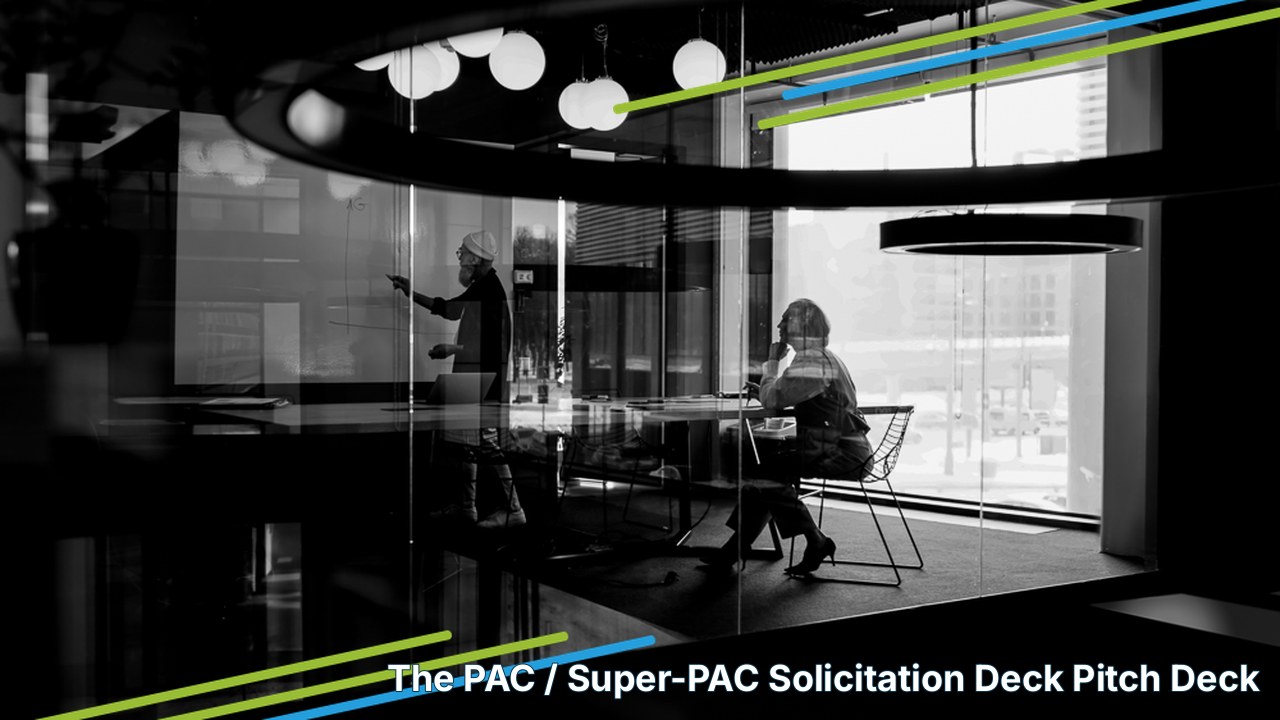
Presentation Gurus — Pitch Deck Breakdown: The PAC / Super-PAC Solicitation Deck
Highlight
- The single most common reason PAC solicitation decks fail is that they read like a general-interest fundraising appeal, not a targeted investment case for a small set of high-net-worth individuals who can write a check anywhere.
- Donors to a PAC are not buying a cause — they are buying a specific theory of change: which races, which margins, which legislative votes, and which timeline map to their political interests.
- The deck’s primary audience is not the donor’s idealism — it’s the donor’s fiduciary and reputational risk calculus, especially for corporate PACs where board and shareholder scrutiny is real.
- A winning PAC solicitation deck organizes around a Risk-Mitigation / Regulatory Arc because the donor’s decision process is fundamentally about protecting and advancing capital, both financial and political.
- The deck must prove it knows the electoral terrain better than the donor does, or the donor has no reason to delegate their contribution to the PAC’s judgment over their own direct giving.
Presentation Design Process
Four Steps, One Simple Process
This is a straightforward, side-by-side collaboration designed to remove all the traditional complexity from the process. We work together seamlessly via Microsoft Teams or your preferred online platform, sharing our screens to review layout, story, and graphics in real time. This allows us to capture your immediate feedback and make instant adjustments on the spot.
It completely eliminates the old, slow friction of scheduling formal office visits and waiting days for revisions. It is faster, highly convenient, and ensures you get exactly what you need to succeed.
Presentation Discovery
We start by learning exactly who’s in the room, then how you want to use the slide deck, the core message, and the one goal it needs to achieve the moment you finish presenting.
Story & Design
First, we build two custom visual direction slide concepts, matched to the goal of the slide presentation. We also map out the story in a simple, un-styled wireframe. Both are completed side-by-side.
Fast Revisions
Quick morning sprints refine the deck together in real time, getting shorter each round, from a full assembly session down to just minutes, until every slide is locked in.
Full Handoff
After revisions, and when you are 100% satisfied with the presentation, you settle the invoice. You’ll get a fully editable file in PowerPoint, Keynote, or Google Slides, plus a half-hour coaching session so you can present with total confidence.
Ready ToGet Started?
Presentation Gurus is open.
Give us a call.
We actually answer the phone.
The Room Where No One Talks About the Real Risk
Every political action committee solicitation deck opens with a version of the same slide: a beaming candidate, a red-white-and-blue color palette, and a tagline about ‘protecting our values.’ Ten slides later, the ask arrives. And most of the time, the donor closes the deck and writes a check to someone else — not because they disagree with the values, but because the deck never acknowledged the question they were actually asking themselves in that room.
That question is: What happens if this contribution becomes a headline? For a corporate PAC director sitting across from a senior vice president, the calculus is not about the candidate’s charisma. It’s about whether a $5,000 contribution to a contested primary ends up in a leaked spreadsheet, triggering a shareholder letter, a board inquiry, or a reputational fire drill that costs the executive more than the contribution was worth. For a major donor to an independent super-PAC, the same dynamic scales: the risk is not that the money is spent poorly — it’s that the association costs the donor access, standing, or legal exposure in ways they didn’t anticipate.
The deck that works does not ignore this tension. It names it, structurally, before the first dollar amount appears. It signals that the PAC understands the donor’s fiduciary and reputational boundaries better than the donor themselves might expect. The pitch becomes: we have done the diligence on the risk so you don’t have to. And that is a much stronger opening move than pretending risk does not exist.
Why a PAC Deck Is Different From Every Other Fundraising Pitch
Most fundraising decks — for startups, for nonprofits, for capital campaigns — operate in a world where the donor’s primary question is ‘what will my money achieve?’ That question is present in PAC solicitation, but it is not the dominant one. The dominant question is: ‘what will my money associate me with, and who will know?’
This is not cynicism. It is a structural feature of how political money moves after Citizens United (2010) and the subsequent wave of state-level disclosure regimes. A corporate PAC operating under federal election law must navigate contribution limits, prohibited-source rules, and reporting requirements administered by the Federal Election Commission. A super-PAC, operating under independent-expenditure rules, faces a different set of constraints — no coordination with campaigns, but unlimited spending and full disclosure of donors over $200. Every contribution leaves a paper trail.
The deck must address this terrain directly. The audience is not a single idealist. It is a committee — or, in a corporate setting, a compliance officer, a government-affairs director, and an executive with a calendar full of board meetings. These people do not make quick decisions about political contributions. They review, they cross-reference, they ask their legal teams to vet. The deck that treats the ask as an impulse buy — ‘join us, donate now, change the world’ — reveals that it does not understand who is reading it.
A credible PAC solicitation deck starts by demonstrating command of the regulatory and compliance architecture. The strongest openings include a slide that is not about the candidate at all: it is about the PAC’s governance structure, its compliance track record, and the specific legal boundaries within which the money will operate. That slide answers the unspoken question before the donor has to ask it.
Building the Deck: From Compliance to Theory of Change
A PAC solicitation deck that follows the wrong sequence — candidate first, then issue agenda, then ask — almost always stalls. The sequence that works mirrors a Risk-Mitigation / Regulatory Arc: start where the donor’s fear lives, move through where their judgment is tested, and arrive at the ask only after the basis for trust is established.
Slide one is not a logo and a slogan. Slide one is the PAC’s fiduciary infrastructure: who manages the funds, what compliance controls are in place, what the audit history shows, and how the PAC ensures that every dollar is spent within the legal and ethical boundaries the donor expects. This slide is not defensive. It is a signal of competence.
Slides two and three layer in the strategic case: the electoral map, the targeted races, the margin analysis. This is where the deck earns the donor’s attention by demonstrating that it knows the terrain. Not ‘we support pro-business candidates’ — but ‘District 7 has a 1.2-point margin from the last cycle, the incumbent’s retirement creates an open seat, and our polling shows the likely challenger is vulnerable on the specific issue that matters to this donor base.’ The specificity is the proof of judgment.
Slides four and five present the issue agenda, but not as a wish list. Frame it as a legislative bottleneck analysis: which committees, which chairs, which procedural hurdles currently block the donor’s priority issues, and how the targeted candidates change that equation. The donor is not funding a campaign. They are funding a specific legislative outcome, and the deck must trace a causal line from contribution to that outcome.
Slide six is the ask: recommended contribution levels, donor tiers, and — crucially — what each tier provides in terms of access, reporting, and strategic input. The ask must feel precise, not open-ended. A super-PAC that asks for $50,000 without specifying what that amount accomplishes in a specific media market is asking the donor to guess. Donors do not guess with large sums.
The final slide returns to risk mitigation: the reporting structure, the communication cadence, the exit provisions if the political landscape shifts. The donor needs to know how they will know the money is working. Close with that promise.
When the Stakes Demand a Specialist Hand
Most PAC solicitation decks are built by campaign staff, communications directors, or government-affairs teams who know the politics cold but have limited experience in high-stakes financial persuasion. The gap that emerges is almost always the same: the deck explains the candidate and the issues brilliantly, but fails to speak the language of fiduciary duty, compliance risk, and return-on-political-investment that the donor’s internal approval process requires.
This is where the craft of the deck fundamentally differs from a campaign brochure. The layout, the visual hierarchy, the data-density balance, and the narrative flow all need to signal that this is a serious financial vehicle, not an advocacy flyer. A font choice, a chart structure, or a color palette that reads as amateurish to a general counsel or a board member can kill a solicitation before a single word is read.
When the donor pool is small and the contribution sizes are large — a common structure for super-PACs and corporate PAC leadership tiers — there is no room for a deck that ‘mostly works.’ The one-on-one meeting is the only shot. A Presentation Gurus work order on a deck like this typically focuses on compressing the regulatory fluency and strategic intelligence into a visual flow that a donor can absorb in under twelve minutes without asking a clarifying question. The donor should finish the deck and already be reaching for their checkbook — not reaching for their phone to call their lawyer.
The Shape of the Story: Why the PAC Deck Follows a Risk-Mitigation Arc
A donor reviewing a PAC solicitation spends their attention looking for exposure points before they ever weigh political outcomes. In high-stakes political giving, the decision process runs strictly on risk-adjusted conviction.
The PAC solicitation deck’s narrative architecture is a Risk-Mitigation / Regulatory Arc. The donor evaluates whether this vehicle reduces exposure to political risk while advancing their strategic interests. The deck maps directly onto that evaluation by moving from: (1) here is the risk you are currently exposed to — uncertainty about where money is safe and effective; to (2) here is the regulatory framework that contains that risk; to (3) here is the specific electoral analysis that mitigates strategic uncertainty; to (4) here is the governance structure that guarantees ongoing risk management.
A donor watching a deck built this way does not feel like they are being sold. They feel like they are being briefed. And a briefing is a format that a corporate executive, a board member, or a high-net-worth investor already trusts. They encounter briefings every day. A solicitation dressed as a briefing is not deceptive — it is empathetic. It meets the donor in the decision mode they already inhabit.
The trajectory moves through diagnosis, containment, confidence, and action. That shape makes it the deck in the donor’s inbox that respects how they actually decide. And that is the deck that gets the check.
Conclusion
Donors who write large political checks evaluate solicitations through a rigorous lens of risk, compliance, and strategic return. The winning deck treats the contribution as an investment in political infrastructure, governed by the same discipline as any other capital allocation. When the deck demonstrates that the PAC understands the donor’s constraints better than the donor expected, the ask becomes a formality. That is the standard to build toward.
If you need help creating a winning Political, Civic & Advocacy Decks pitch and would like our presentation specialists’ help, call J.R. for a complimentary discovery and review of your project.
References
-
Federal Election Commission
— Contribution Limits and Prohibited Sources (Corporate and Labor PACs) — https://www.fec.gov/help-candidates-and-committees/candidate-taking-receipts/contribution-limits/
Grounds the regulatory architecture that a PAC solicitation deck must acknowledge in its opening slides. -
Federal Election Commission
— Independent Expenditure-Only Committees (Super PACs) — https://www.fec.gov/help-candidates-and-committees/independent-expenditures/
Establishes the distinct compliance framework for super-PACs, which shapes the disclosure-risk section of the deck. -
Citizens United v. Federal Election Commission, 558 U.S. 310 (2010)
— Supreme Court opinion — https://supreme.justia.com/cases/federal/us/558/310/
Provides the legal context for independent expenditure committees and the disclosure regimes that follow from the ruling. -
Center for Responsive Politics (OpenSecrets)
— Methodology for Tracking Political Contributions and Donor Disclosure — https://www.opensecrets.org/
Supports the argument that donor transparency and reputational risk are real, measurable factors in PAC solicitation. -
Internal Revenue Service
— Political Organization Filing and Disclosure Requirements (IRS Form 8871, 8872) — https://www.irs.gov/charities-non-profits/political-organizations
Confirms the tax-compliance layer that corporate PACs and super-PACs must navigate, relevant to the fiduciary-risk section. -
Securities and Exchange Commission
— Guidance on Corporate Political Spending Disclosure (Shareholder Proposals) — https://www.sec.gov/corpfin/staff-legal-bulletin-14e-shareholder-proposals
Underscores the board-level and shareholder scrutiny that corporate PAC directors face, which the deck must preempt. -
The Campaign Legal Center
— Dark Money and Disclosure: A Primer on Independent Expenditure Reporting — https://campaignlegal.org/
Provides analysis of disclosure gaps and donor-identity risks that shape the reputational calculus for large super-PAC contributors.
Written By Presentation Gurus

Creative Director
J.R. founded Presentation Gurus in 1997, growing a marketing side hustle into a global studio serving startups, investors, and Fortune 500s. With three decades of experience, he personally leads every project as the client contact. He applies this same narrative-first process—honed across thousands of pitches—to every article, guide, and case study. Learn More
More Pitch Deck Breakdowns
The Ballot Initiative Campaign Deck: Selling a Vote Before It Reaches the Voter
Read the breakdown →
The Political Campaign Fundraising Pitch: Selling Viability When Trust Is the Only Currency
Read the breakdown →
The Brand Licensing Expansion Pitch: Selling the Business Case to the Brand Owner Who’s Seen It Go Wrong
Read the breakdown →